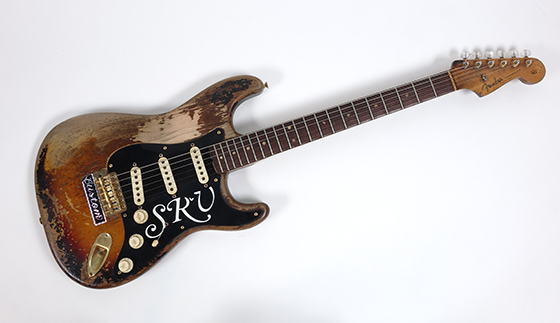
Stevie Ray Vaughan's Number One is a heavily modified early-'60s/late-50s Stratocaster that stopped being factory-original early in its life, being rebuilt constantly in a life of heavy touring. The body dates to 1963. The neck is widely cited as a '62 (often specifically December '62). The pickups are dated 1959, leading Stevie to personally refer to the instrument as a '59. None of those parts started life together, which was not unusual for working Strats at the time. What made it Number One wasn't rarity or condition — it was the bond Stevie formed with it over years of use.
Why This Guitar Matters
- Played on nearly every major SRV recording from Texas Flood (1983) through In Step (1989), including "Pride and Joy," "Texas Flood," "Couldn't Stand the Weather," and "Tin Pan Alley" and in countless live shows
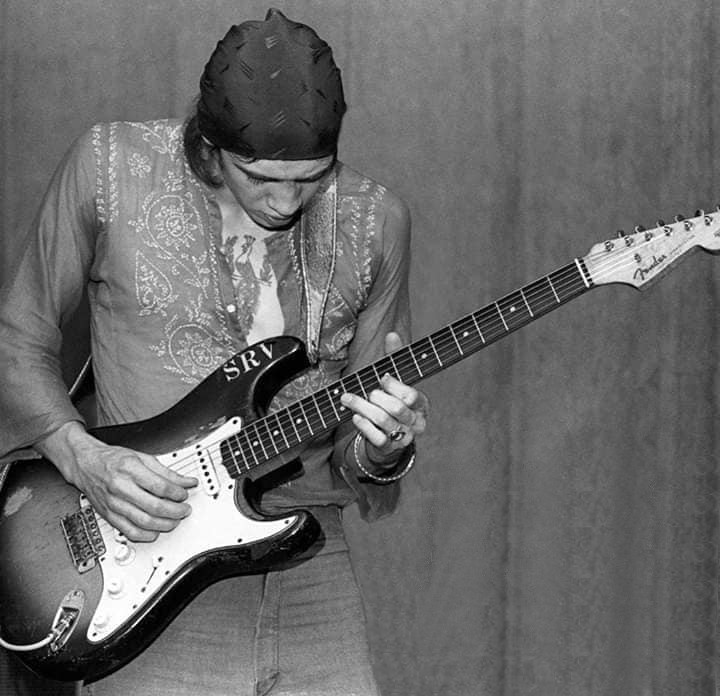
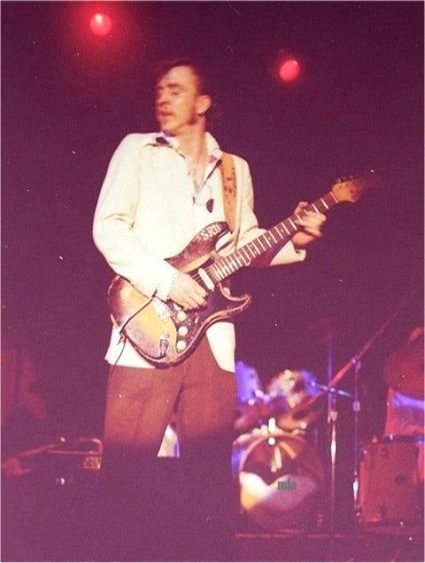
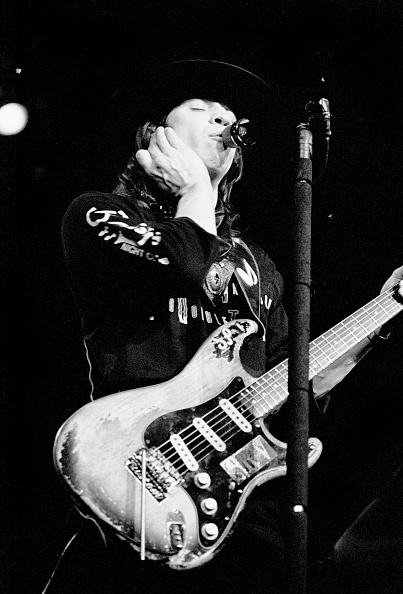
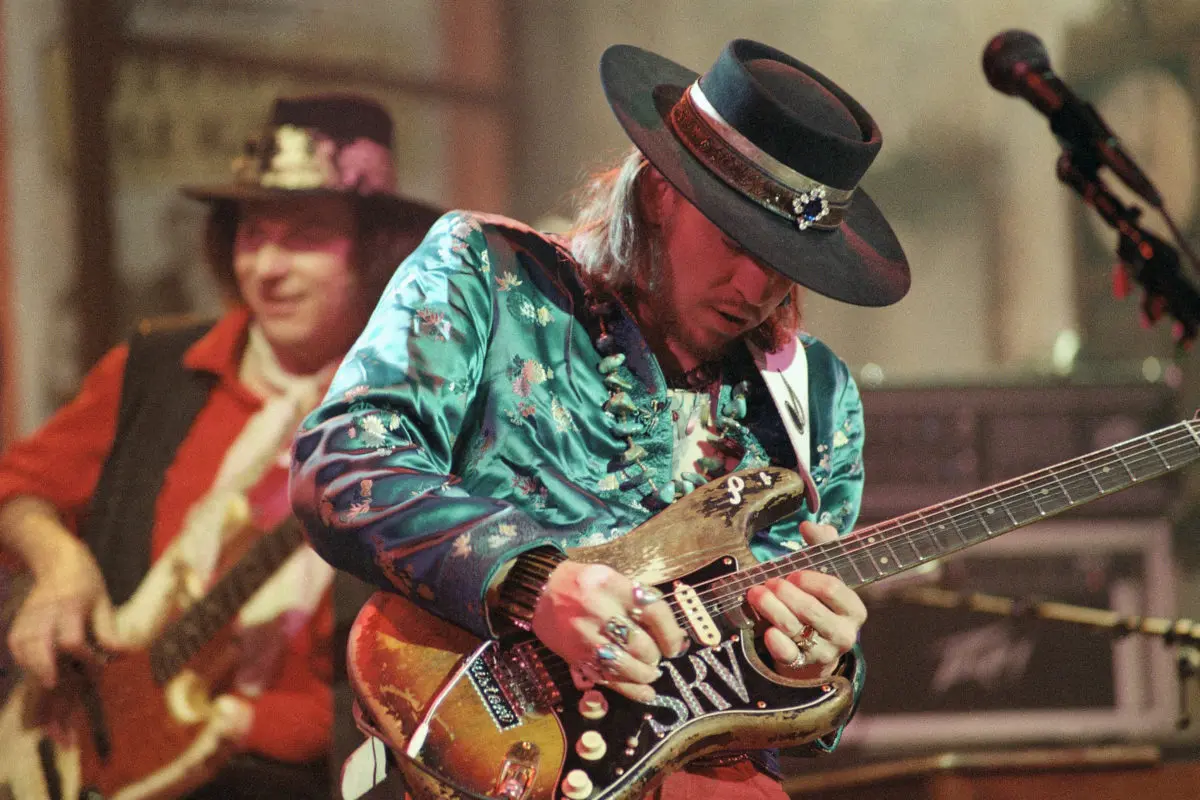
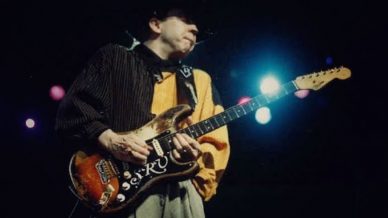
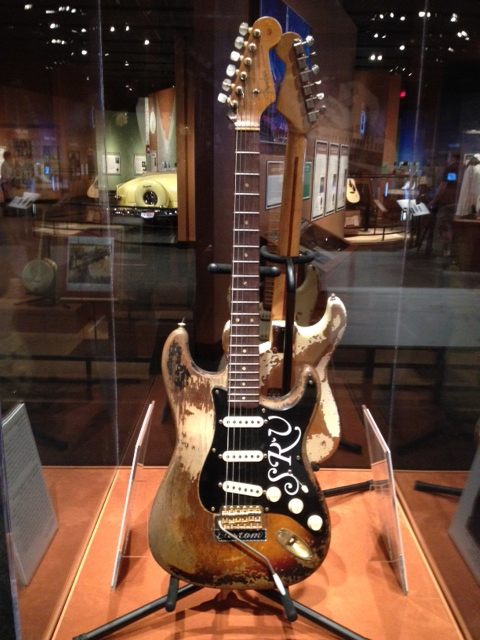
- Visually defined by two deliberate choices: the reversed trem arm (left-handed orientation on a right-handed body) and the black pickguard with "SRV" letters — the white-to-black swap is timestamped to April 1979
- The tone people associate with SRV is inseparable from this guitar's setup: heavy strings, Eb tuning, a refret-flattened fingerboard radius, and an attacking right hand
- Acquired already worn from Ray Hennig's Heart of Texas Music in Austin, 1973–74 — never a collector's piece, always a working instrument
- The reversed trem was a deliberate ergonomic choice — SRV explained it in a 1984 interview as a practical technique preference
- Currently in Jimmie Vaughan's collection
The Instrument
Specs
| Feature | Detail | Source |
|---|---|---|
| Make / Model | Fender Stratocaster | — |
| Year / parts era | '63 body, '62 neck (often cited Dec '62), '59 pickups [Likely→Confirmed] | SRV Archive; Craig Hopkins; Fuzzfaced.net (Custom Shop inspection) |
| Body | '63 Strat body, sunburst finish, heavily worn [Likely] | SRV Archive |
| Neck | '62 Strat neck; profile described as thick/D-ish; nut width often cited as 1-5/8" [Likely] | SRV Archive; Craig Hopkins |
| Fingerboard | Rosewood; radius started at 7.25" and reportedly flattened toward ~9–10" over years of refrets [Likely] | SRV Archive; Craig Hopkins |
| Pickups | '59-dated Fender single-coils [Likely] | SRV Archive; Fuzzfaced.net |
| Pickguard | White originally → black at end of April 1979 [Confirmed]; "SRV" letters added early '80s [Likely] | SRV Archive |
| Bridge / trem | Right-handed body with left-handed trem orientation ("flipped") [Confirmed] | Craig Hopkins — custom trem bar; Guitar Player, 1984 |
| Tuners | Schaller Elite Gold in at least one documented configuration [Likely] | SRV Archive |
| Strings & tuning | GHS Nickel Rockers .013–.015–.019p–.028–.038–.058; Eb tuning [Confirmed] | SRV Archive — strings (cites René Martinez) |
| Notable mods | Flipped trem; repeated refrets; neck swaps late '80s; original neck reinstalled post-1990 [Likely→Confirmed] | ACL Gear Blog; SRV Archive |
| Current location | Jimmie Vaughan [Confirmed] | Widely reported |
What This Guitar Actually Sounds Like
- Attributable to the guitar: vintage-output '59-era single-coils, 25.5" scale, rosewood-board Strat response, and how those pickups react when you hit them hard with heavy strings. The effective fingerboard radius flattened over years of refrets, which made aggressive bending cleaner.
- Rig-dependent: the "fat Strat" character also requires clean headroom and a mid push. The guitar alone doesn't do the whole trick.
- Player-dependent: SRV's attack and vibrato. Without the right-hand approach, the same parts sound like any other Strat.
Provenance: Where It's Been
How the artist got it
The acquisition is anchored to Austin: SRV found Number One at Ray Hennig's Heart of Texas Music, already in rough shape and apparently affordable — a working Strat, not a collectible. Hennig's own telling of the story is documented in the Bullock Texas State History Museum's Texas Story Project, which frames the moment as the guitar finding its player.
Sources differ on the exact year: 1973 appears in some accounts, 1974 in others. Both show up in credible writeups.
Ownership timeline
| Period | Owner | How acquired | Notable changes |
|---|---|---|---|
| Pre-1973/74 | Prior owners | Unknown | Parts mix (different date stamps) already in place |
| 1973/74–1990 | Stevie Ray Vaughan | From Ray Hennig / Heart of Texas Music, Austin [Confirmed-ish] | Black pickguard installed (April 1979), flipped trem, repeated refrets, neck swaps late '80s |
| 1990–present | Jimmie Vaughan | Returned to family after SRV's death | Original neck reinstalled; occasionally exhibited |
Timeline: How It Changed
| Era | What changed | Why | Evidence |
|---|---|---|---|
| Pre-acquisition | Parts-era composition in place: '59 pickups, '62 neck, '63 body [Likely] | Common for working Strats to accumulate swapped parts | Multiple inspections and teardowns; SRV Archive + Craig Hopkins summary |
| 1973–74 | SRV acquires the guitar | It was already worn; became his main guitar quickly | Bullock museum account; SRV Archive acquisition note |
| April 1979 | Pickguard changes from white to black [Confirmed] | Practical and aesthetic | SRV Archive explicitly dates it |
| ~1980 | René Martinez disassembles it, observes '63 body stamp and '62 neck stamp [Likely] | Routine deep maintenance | SRV Archive states this directly |
| Early–mid 1980s | Repeated refrets; effective radius flattens toward ~9–10" [Likely] | Heavy touring wear; Dunlop 6100 fret wire often cited | SRV Archive + Craig Hopkins both describe refret-driven radius change |
| 1984 | SRV explains left-handed trem choice on record [Confirmed] | Technique and ergonomics — more than Hendrix influence | Guitar Player writeup referencing the 1984 interview |
| Late 1980s | Original neck becomes unworkable; neck swap(s) occur [Likely] | Too many refrets; structural wear | ACL Gear Blog summarizes late-'80s swap |
| ~Summer 1990 | Neck on the guitar broken by falling stage rigging [Likely] | Accident | ACL Gear Blog |
| Post-1990 | Original neck reinstalled [Confirmed] | Restoration to canonical configuration | ACL Gear Blog + SRV Archive |
The through-line across all these changes: the pickups and the basic Strat platform were the constant. The real variables were fretwork, neck configuration, and trem ergonomics. A flatter effective radius plus tall frets plus Eb tuning with heavy strings makes aggressive bending cleaner — which is exactly how he played.
Visual Record
Essential Listening
These recordings aren't guaranteed "only Number One" documentation, but they're the SRV reference recordings where the combination of guitar, setup, and playing is the sound people are trying to understand.
- "Pride and Joy" (Texas Flood, 1983) — Listen to the percussive snap on the low strings under a hard attack; clean headroom reveals what the pickups are doing.
- "Texas Flood" (Texas Flood, 1983) — Slow-blues sustain where the Strat keeps edge rather than going soft; bends in the lead are audibly comfortable, which is the refret job doing its work.
- "Couldn't Stand the Weather" (Couldn't Stand the Weather, 1984) — Aggressive attack, bright but thick. Useful contrast with "Lenny" — same guitar, very different approach.
- "Tin Pan Alley (Roughest Place in Town)" (Couldn't Stand the Weather, 1984) — Long sustained notes with control; you can hear the action and the discipline in the right hand.
- Live "Voodoo Child (Slight Return)" (any 1983–1990 clip) — This is where the flipped trem reads as a practical ergonomic choice rather than trivia. He uses it constantly; the way he reaches for it is different than a right-hand orientation would allow.
Market Context
The comparable basket
If you're buying toward Number One as an instrument — not a museum piece — the search looks like this:
1962–1964 Fender Stratocaster, rosewood board, '50s vintage-style or texas special single coils, player grade, originality flexible
Why those constraints matter: the early-'60s pre-CBS pickup and neck ecosystem is the feel people are actually chasing. "Player grade" isn't a compromise here — it's the point. Number One is famous partly because it's wrecked.
Relevant AxeDB model pages: Vintage Stratocaster SRV Signature Stratocaster John Mayer Signature Stratocaster (inspired by Mayer's own SRV signature model)
What actually drives price in this segment
- Original finish vs. refin — refins typically cut collectability significantly; player value varies more
- Neck date and originality — swapped necks can be fine for players, significant problem for collectors
- Pickup originality — period-correct early-'60s pickups carry value independent of the guitar
- Structural repairs — headstock breaks, routed bodies, and replaced parts are major discounts at the top end
Famous-guitar premium vs. instrument premium
SRV's actual guitar is provenance-only pricing — it's not a Strat market number at all. For players, the closest attainable equivalent is a good early-'60s Strat (or a serious reissue) with a neck and fretwork that can handle abuse, set up for Eb. The "Number One sound" is that combination of setup choices more than any specific hardware.
Get Your Own
Off the shelf
The Fender SRV Stratocaster signature model gives you the reversed trem, gold hardware, Texas Special pickups, and sunburst finish, which is a good starting point. A new one will set you back nearly $2,300 at the time of wriging this, but AxeDB data shows that they regularly sell for $1300-1900 on the used market.
Vintage sweet spot
1962–64 Strat, player grade. Don't overpay for "clean" — you're trying to recreate a guitar that was functionally rebuilt over 17 years of hard use. Refins are okay but an SRV strat should really have a nitro finish if you ever want to earn your own play wear on it like his, I'd stay away from a poly refin. Non-original pickups aren't a deal breaker either, since at that point you can swap in some Texas Specials which were basically designed with an SRV tone in mind.
Build your own
- Body: Alder Strat body, sunburst finish; relic optional, ideally nitro finish
- Neck: Chunky carve, rosewood board; prioritize fret condition over vintage-correct spec
- Pickups: Vintage-output single-coils or Texas Specials
- Setup targets: Eb tuning; action high enough to ring cleanly under a hard attack; trem stable (decked or floating per preference)
- Bridge:: Lefty
- Hardware:: Gold hardware, Schaller Elite tuners if you can find them (these can be hard to source)
Myths and Disputes
- Myth: "It's a 1959 Stratocaster." → Reality: The '59 label comes from the pickup date stamps. Multiple inspections describe a '63 body and '62 neck; the '59 designation was SRV's shorthand for the pickups.
- Disputed: Exact string gauges, year by year. → Best read: The gauges changed over time. SRV Archive documents the "SRV set" discussion without treating it as a single fixed spec — the "classic .013s" narrative is one version of the story, not the whole story.
- Disputed: When the "SRV" letters appeared on the pickguard. → Best read: The white-to-black pickguard swap is specifically dated to April 1979 by SRV Archive. The letters themselves are commonly described as early '80s, but sources don't all agree on a precise date.
FAQ
What year is Number One really? Parts-era early-'60s Strat. The most consistent breakdown across independent inspections: 1959 pickups, 1962 neck (often cited as December '62), 1963 body. None of those parts were original to each other.
Why does everyone call it a '59? Because the pickups carry 1959 date stamps, and SRV himself called it a "'59 Strat" for years. The body and neck dates are later.
When did the pickguard change from white to black? SRV Archive places the swap at the end of April 1979. The "SRV" letters came later — generally described as early '80s, but the exact timing varies by source.
Why is the trem arm reversed? SRV deliberately set up a left-handed tremolo orientation on the right-handed body. He explained the reasoning in a 1984 Guitar Player interview — it was a technique and ergonomics choice, not solely a Hendrix reference. Watch any live footage of him using the bar and the reach makes sense.
Did he really swap the neck? Yes. By the late '80s, the original neck had been refretted so many times that it was functionally worn out, and the guitar spent stretches of time with different necks. The original was reinstalled after his death in 1990.
What strings did he use? GHS Nickel Rockers, gauged .013–.015–.019p–.028–.038–.058, confirmed by René Martinez (his long-time guitar tech). Note the plain G string (.019p) — unusual for a set this heavy. Tuned down a half-step to Eb, which brought the tension to something closer to a standard .012 set in standard pitch. The Eb tuning is not debated; the specific gauges are well-documented but likely varied in his earlier years before he settled on this setup.
Where is it now? With Jimmie Vaughan.
How much is it worth? The original, one-of-one Number One is priceless and Jimmie will probably never sell it. It might fetch seven figures if it ever ends up at auction.
As for what your best replica might set you back, there's options:
- Production SRV Signature strat: $2,300 new, $1500 used.
- Custom shop model: $3.5-5.5k, or upwards of $35k if you look at the very-limited run of master built replicas.
- Vintage player-grade early 60s strat: $10-15k (assuming it's in somewhat rough or non-original condition which seems appropriate for an SRV homage)
What's the closest guitar I can actually buy? A 1962–64 Strat in player grade, or a serious reissue with vintage-output singles. The setup matters as much as the hardware: Eb tuning, heavy strings, and a neck/fret job that can handle big bends.